
Pack Check
Tuesday, June 23, 2026
How to Raise Kids Who Show Up Prepared
When I was in the Army, we were drilled on the importance of knowing where our gear was. At ALL times.
And the reason why is because gear is one of the simplest expressions of ownership and responsibility.
If you can't keep track of your own gear, how can you be trusted with the mission?
Or your weapon?
Or with your battle buddy?
So losing ANY gear had solid consequences.
I still remember what happened when someone lost their cover (hat) in basic training.
It was cold and wet in Missouri. We were at formation at 5AM. And someone couldn't find their cover.
As punishment, the Drill Sergeants made them run around the entire company yelling:
"Has anyone seen my cover?"
Over.
And over.
And over again.
Was it embarrassing?
Absolutely. And did it end there? No it did not.
It ended in us all doing long extra training in the mud to account for our "buddies" lost gear.
And one thing I learned right then and there...you never want to be THAT guy.
But was the lesson really about the hat? No.
It was about discipline.
And that's a lesson I think many kids are missing today.
When a water bottle gets left behind, we replace it.
When a jacket gets forgotten, we give them ours.
When gear disappears, parents often absorb the consequences.
We do it because we love our kids and don't want them to struggle.
But sometimes the unintended lesson becomes:
"Someone else will remember for me." And that's a dangerous habit.
Because one day the stakes will be bigger than a forgotten water bottle.
So, that's why we started doing pack checks.
Step 1: Every Piece of Gear Needs a Home
If gear doesn't have a home, kids can't be responsible for it.
Create a designated location for:
-backpacks
-water bottle
-flashlight/headlamp
-gloves
-knife (if age appropriate)
-first aid kit
-mission gear
The rule: Gear always returns home after use.
Not tomorrow.
Not later.
Immediately.
Step 2: Build the List Once
Don't rely on memory. Create a laminated gear list or card. It can even be a simple index card.
For example:
Pathfinder Essentials
□ Water bottle
□ Headlamp
□ Gloves
□ Notebook
□ Pencil
□ Whistle
□ Pocket knife
□ Mission-specific gear
Put the list: in the backpack, on the wall, or near the gear station
Kids should be able to check it without asking.
Step 3: Pack the Night Before
Morning brains are terrible.
Pack checks happen: The night before.
This removes: rushing, stress, forgotten gear.
It also teaches planning.
Step 4: Pack With Them Before Packing Without Them
This is where many parents skip ahead. I skipped this with my oldest, and learned the hard way. (First pancake problems).
But the first few times, get your index card, and go through each item and where to put it.
Ask:
"Why do we carry this?"
"Where does it go?"
"What happens if we forget it?"
Help them connect gear to purpose.
Purpose creates ownership.
Step 5: Random Pack Checks
This is where it gets fun.
Every random once in a while we call: "GEAR CHECK."
Our boys have 2 minutes to find their bags.
And we open them. We see what's inside. It's usually a surprise! Sometimes good...sometimes bad.
I'd suggest doing this before you really have to go somewhere.
It keeps it fun, and not as stressful when you're not on a time crunch.
Step 6: Let the Trail Teach
This one matters.
If a kid forgets his gloves: Don't rescue immediately.
Let reality do some teaching.
This time, it might be cold hands that have to stay in pockets instead of playing in the snow.
If he forgot his flashlight: This time he has to share a light with someone else,andt he can't be the one to hold it and have more freedom.
The goal is ownership.
Natural consequences stick longer than lectures.
Step 7: Praise Preparation
When a kid remembers everything: praise the heck out of it.
Super simple, but easy to forget when trying to manage other life details
Step 8: Increase Responsibility Over Time
Age 4:
-carry backpack
-carry water
Age 8:
-complete own pack check
Age 12:
-manage all personal gear
Age 14:
-responsible for helping younger siblings
Responsibility grows.
The Real Goal
So this really isn't just about a packed backpack.
The goal is a kid who learns to think ahead.
Because one day the things he's responsible for won't be: gloves, water bottles and headlamps.
It'll be: commitments, work, family, and people who depend on him.
Pack checks just happen to be where the lesson starts.
And when they are all grown up...you don't want your adult son to be that one guy running around either literally or figuratively yelling:
"Has anyone seen my cover?!"
-Rachelle
Enter your email to keep reading
This is for subscribers only. Enter your email below to continue reading for FREE:
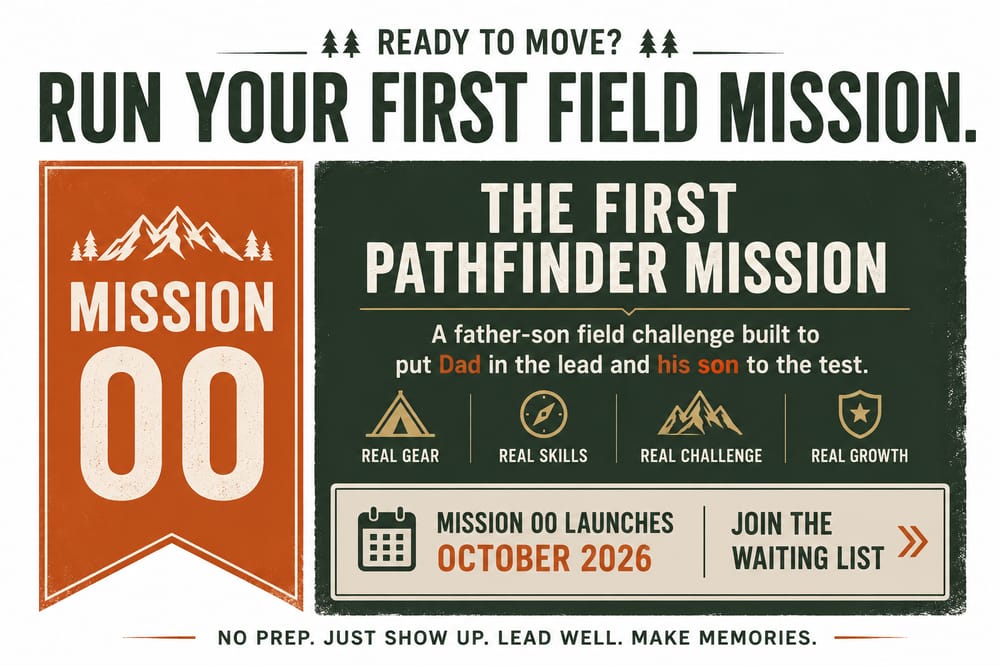
Other ways to connect with your son
1. Want the shortcut? Download the Free Field Guide for Raising Strong Sons — 7 hard-earned lessons every dad should know. No fluff. Just what works.
2. Run the FATHERHOOD SYSTEMS CHECK — A quick, 3-minute gut check to see if you’re leading your son… or just reacting to life.
3. Ready to go all in? Start the 3-Day Dad Challenge — This isn’t advice. It’s action. Three days. Three missions. See what kind of man your son is watching.